
Hi, I'm Thijs.
Physicist, Researcher & Data Consultant
I am a passionate physicist with a strong background in data analysis and consulting. Welcome to my personal portfolio where I share my academic research, professional experience, and publications.
PhD Research
On Droplets and Sprays
On April 17, 2026, I successfully defended my thesis and obtained my PhD! This was the crowning achievement of a journey that started in December 2021. After finishing my Master's in Physics (Summa Cum Laude), I briefly worked as an independent data consultant, building predictive logistics algorithms and anomaly detection systems.
However, I knew I wanted to further develop my analytical and fundamental problem-solving skills, which led me to pursue a PhD in experimental fluid dynamics. My research focused on the physics behind the formation, flight, and impact of droplets. Ultimately, this research aimed to make agricultural spraying more efficient and environmentally safe by tackling two conflicting physical challenges: minimizing drift, which consists of the small droplets that are blown away by the wind and pollute the environment, and preventing the remaining spray from bouncing off water-repellent crop leaves.
Following an additional half-year as a postdoctoral researcher, I decided it was time to explore new challenges. Over the past four and a half years, I built custom experimental setups, utilized state-of-the-art high-speed cameras and laser diffraction methods, and processed the massive amounts of data they generated. The culmination of all this work is my thesis, entitled "On Droplets and Sprays".
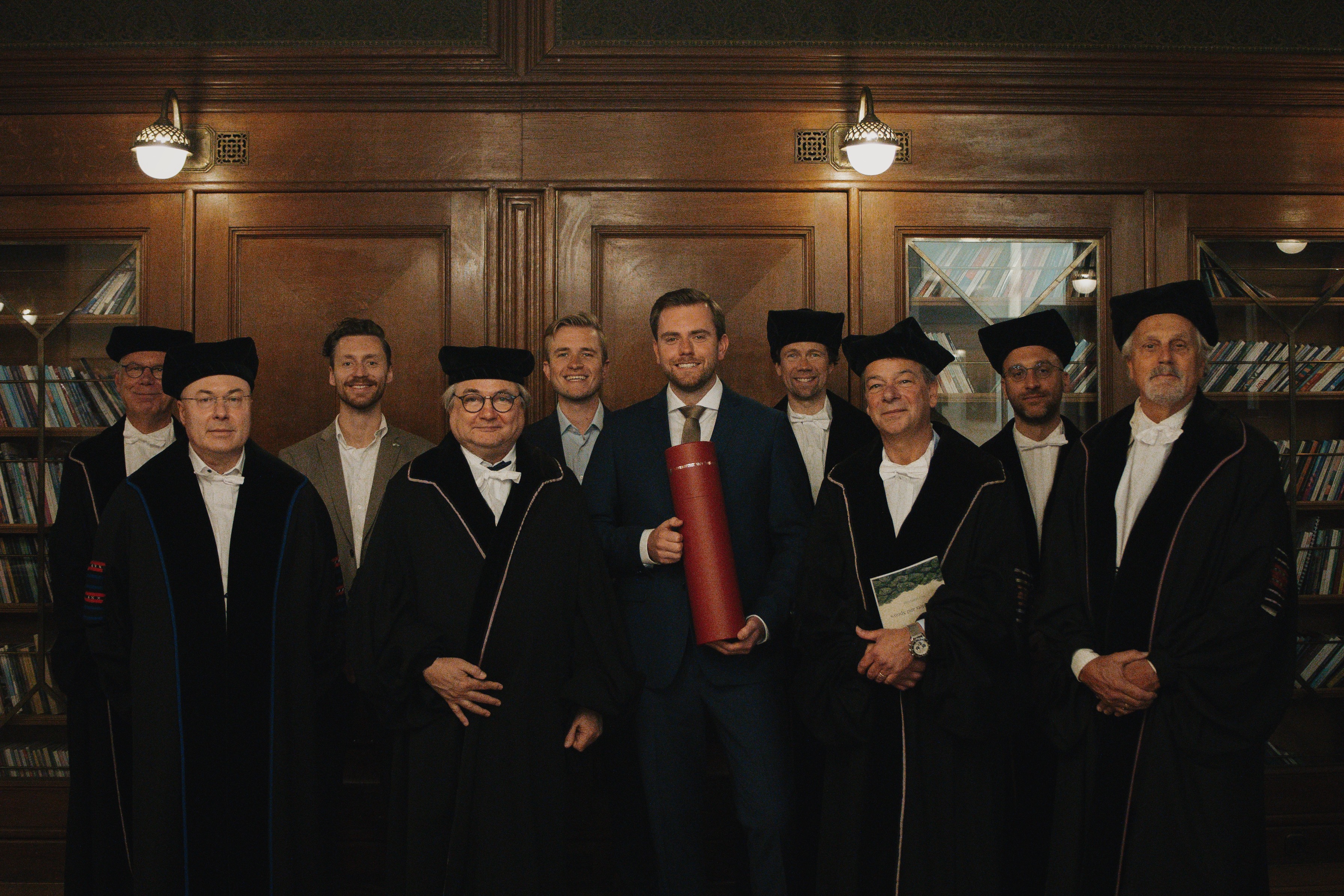
Celebrating the successful defense with the committee.
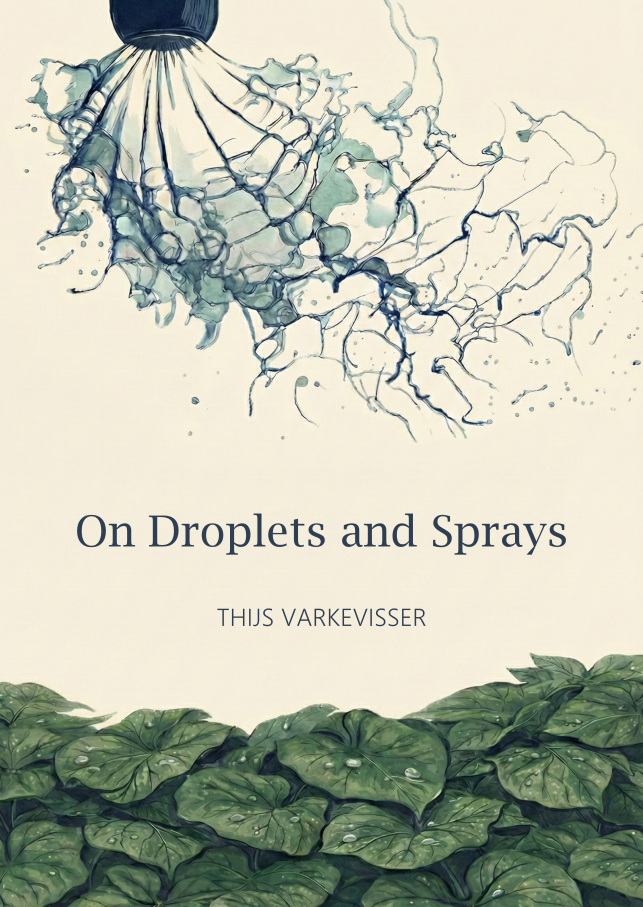
You can download the full thesis here.
The physics of liquid fragmentation and droplet impact
In agriculture, fine spray droplets smaller than 100 micrometers easily blow away in the wind. This phenomenon, known as drift, is highly detrimental to both the environment and human health. In fact, medical consensus increasingly links this environmental exposure to Parkinson's disease, the fastest growing brain disease globally. Because drift creates a direct pathway for human exposure, optimizing spray efficiency is no longer just an agricultural engineering problem, but an urgent matter of public health.
To address this, my research explored the fundamental fluid dynamics of spraying. We first investigated how high wind speeds affect droplet formation, revealing that strong airflow inflates liquid sheets into "bags" that violently burst into drift-prone fine droplets. To combat this fragmentation, we tested the addition of dilute viscoelastic polymers. The results demonstrated that these additives significantly suppress the aerodynamic breakup, reducing drift by up to threefold.
Shifting the focus from droplet creation to crop retention, we also investigated the impact dynamics of viscous and polymer droplets on water-repellent leaves. We demonstrated that fluid viscosity can suppress droplet rebound, a process governed by the dynamic receding contact angle. Furthermore, using a novel sliding-drop rheometry technique, we showed that this suppression in polymer droplets is driven by elastic normal stresses generated by polymer stretching rather than interfacial adsorption.